产品选型

BSPT Thread Guide: Tapered British Pipe Threads

An answer-first guide to BSPT pressure-tight pipe-thread arrangements and their inspection.

阅读 57
BSPT Thread Guide: Tapered British Pipe Threads

Overview

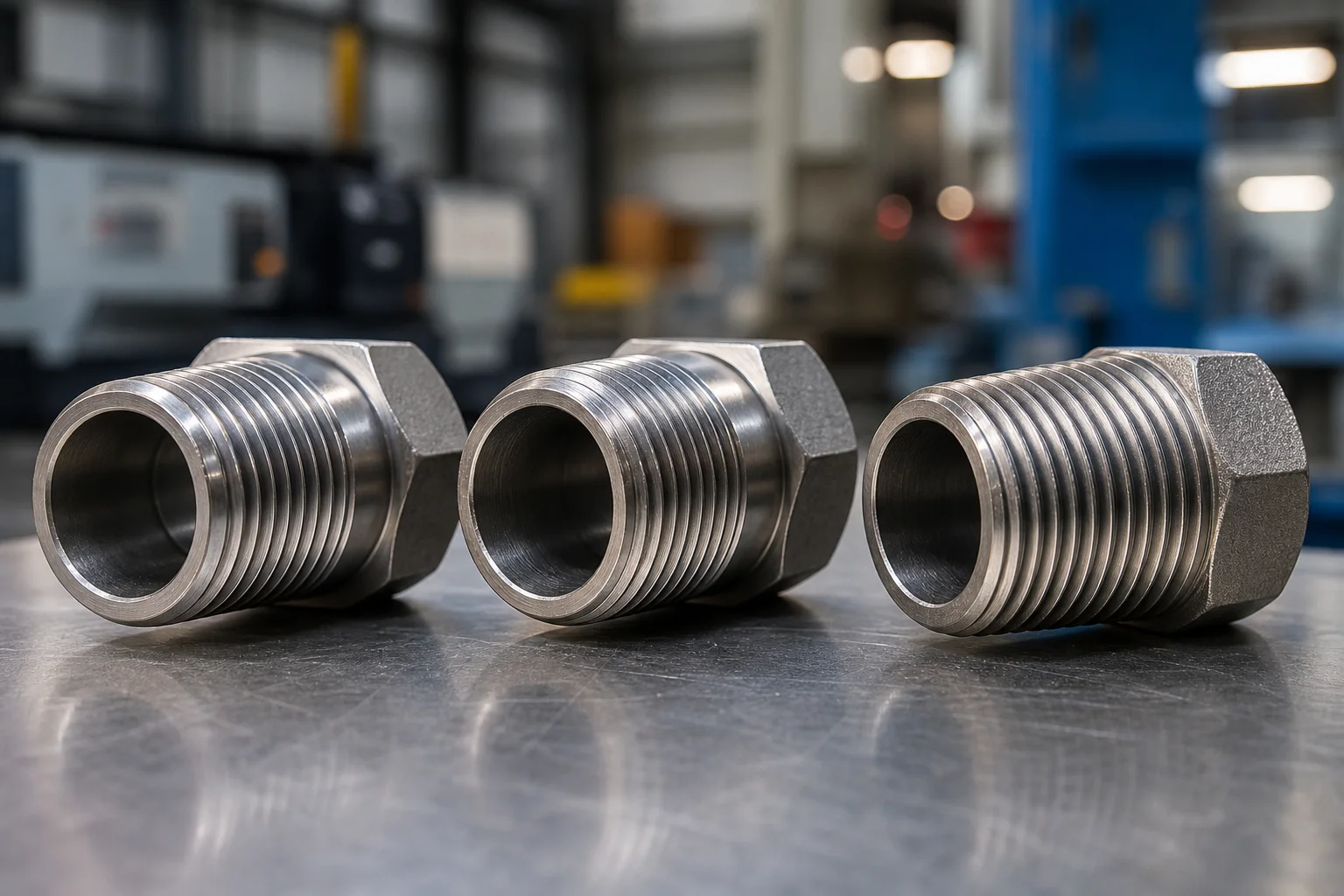
BSPT is a common trade term for tapered British pipe threads used in pressure-tight threaded joints. Under the ISO 7 system, external tapered threads are designated R, while internal threads can use Rc for tapered internal form or Rp for parallel internal form in defined mating arrangements. Commercial catalogs may still use “BSPT” broadly, so the drawing should state the exact designation.

BSPT threads are based on a 55-degree thread profile. They are not interchangeable with NPT, which uses a different profile and dimensional system. They are also different from BSPP or G threads, which are parallel fastening threads and normally seal at a washer, O-ring, gasket, or seat.

BSPT thread tapered British pipe threads guide

Why It Matters for Pipe Components

A BSPT and NPT connection may start to engage but develop incorrect flank contact, shallow thread engagement, or leakage. Applying more sealant does not make mismatched thread forms compatible.

Internal BSP thread terminology can be confusing because a pressure-tight ISO 7 joint may combine a tapered external R thread with either a tapered Rc or parallel Rp internal thread as specified. The buyer should not assume every female British pipe thread is BSPP.

Correct gauging and sealing depend on the exact thread designation. A generic “BSP gauge” is not sufficient for every tapered and parallel form.

Methods, Parameters, or Process

Identify the thread from designation, geometry, pitch, and sealing concept rather than from one measurement.

FeatureBSPT / ISO 7 conceptProcurement check
Profile55-degree Whitworth-derived formUse the correct profile and pitch gauge
External threadR tapered external formState nominal size and R designation
Internal threadRc tapered or Rp parallel as specifiedIdentify the exact mating arrangement
SealingPressure-tight joint made on threads with approved jointing materialConfirm sealant and service approval
Nominal sizeDesignation, not direct measured diameterUse controlled standard dimensions
InspectionStandard-specific plug or ring gaugingGauge type, calibration, and acceptance position

Supplier and Inspection Checklist

  • Write the exact R, Rc, or Rp designation where applicable.
  • State nominal size, internal or external form, and required standard edition.
  • Confirm taper and pitch before comparing diameters.
  • Use gauges intended for the exact ISO 7 thread form.
  • Inspect thread starts, burrs, chatter, dents, and coating buildup.
  • Confirm the mating component uses a compatible BSP pressure-tight thread arrangement.
  • Select jointing material for the fluid, pressure, temperature, and local rules.
  • Do not force NPT components into BSPT ports.
  • Protect threads after final inspection.
  • Perform the required leakage or pressure test.

Application to Pipe Fittings, Valves, and Flanges

BSPT connections appear on threaded fittings, valves, pumps, gauges, pneumatic equipment, and international machinery. Adapters may combine BSPT with NPT, BSPP, metric, compression, or tube-fitting ends. Every end should be identified separately.

For forged and malleable-iron fittings, the product standard controls dimensions and ratings while the thread standard controls thread form. Both must appear in the purchase description.

FAQ

What does BSPT stand for?

It commonly means British Standard Pipe Taper. Technical drawings should use the exact applicable thread designation and standard.

Is every female BSPT thread tapered?

Not necessarily in commercial language. ISO 7 pressure-tight arrangements can use Rc tapered or Rp parallel internal threads with an R external thread.

Can BSPT connect to NPT?

They should not be treated as interchangeable because profile and dimensions differ.

Is BSPT the same as BSPP?

No. BSPT refers to pressure-tight thread arrangements, while BSPP or G threads are parallel and normally use a separate sealing element.

Does BSPT require sealant?

The approved jointing method depends on the thread arrangement, component, service, and project rules.

Next Steps

Replace generic BSPT wording with the exact nominal size and R, Rc, or Rp designation. Confirm the mating part, gauge method, jointing material, and leakage test.

Request a Quote

相关文章

Pipe Thread Types and Inspection for Fittings and Valves
产品选型

Pipe Thread Types and Inspection for Fittings and Valves

A technical guide to identifying and inspecting pipe threads before assembly or shipment.

BSPP Thread Guide: G Threads, Sealing, and Inspection
产品选型

BSPP Thread Guide: G Threads, Sealing, and Inspection

Explains BSPP parallel pipe threads, sealing methods, designations, inspection, and purchasing requirements.

BSP vs NPT Threads: Differences, Identification, and Compatibility
产品选型

BSP vs NPT Threads: Differences, Identification, and Compatibility

A practical comparison of BSPP, BSPT, and NPT threads for industrial purchasing and inspection.

河北诺安在线客服 - 管件阀门法兰报价咨询

在线客服

连接中

有问题随时咨询,我们会尽快回复您