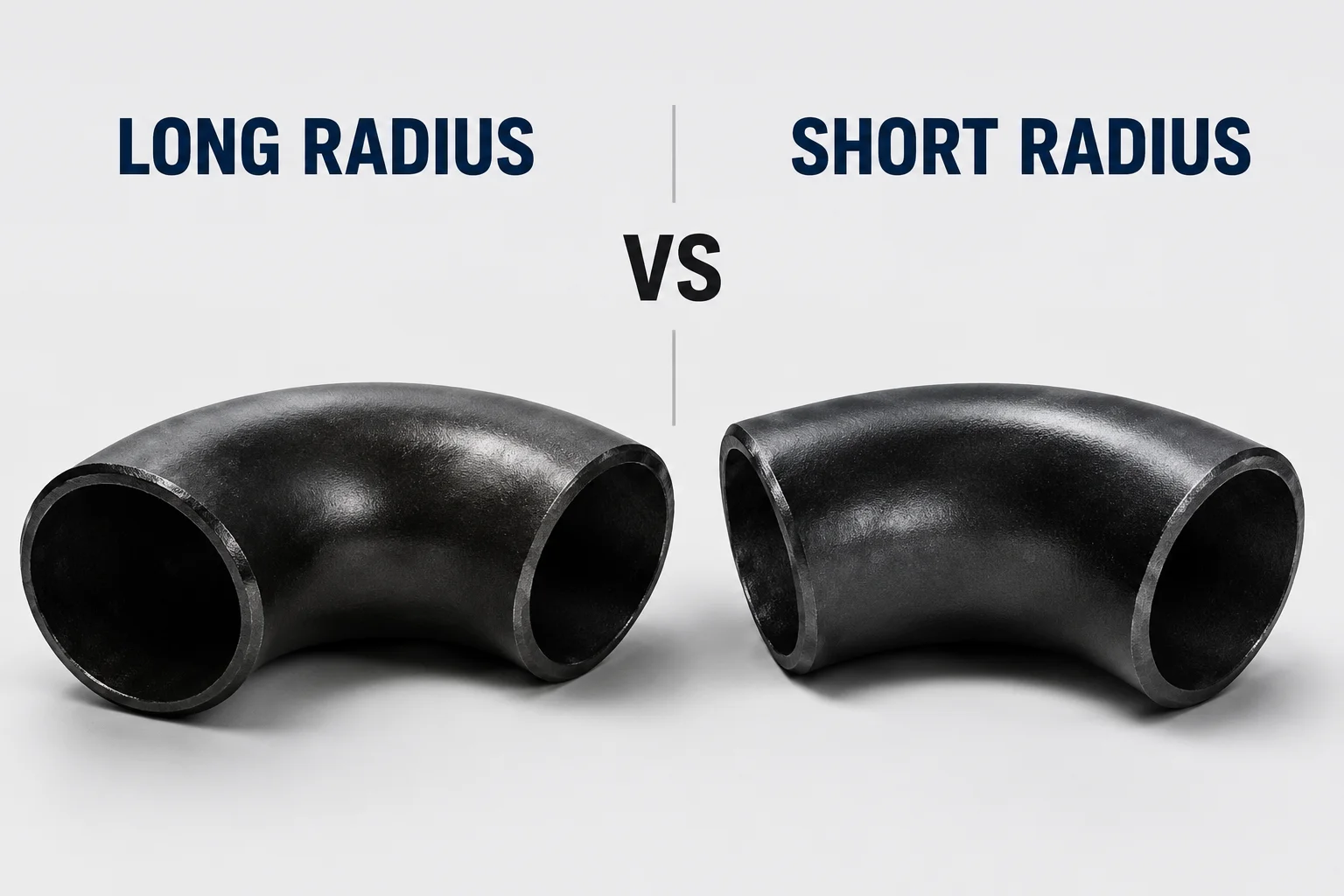
Descripción general
Un codo de 90 grados de radio corto cambia la dirección de la tubería 90 grados en un radio de línea central más compacto que un codo de radio largo. En la terminología común de accesorios de soldadura a tope, SR y LR identifican diferentes geometrías que afectan el diseño, el flujo, la caída de presión, la erosión y la tensión. La base dimensional exacta debe provenir de la norma de montaje seleccionada o del plano del proyecto.
Una descripción de compra debe indicar codo de 90 grados, radio corto, tamaño, espesor de pared o programa, material, construcción soldada o sin costura cuando sea necesario, bisel, estándar y pruebas.
Por qué es importante para los componentes de tuberías
Los codos de radio corto ahorran espacio pero crean un cambio más brusco en la dirección del flujo. Esto puede aumentar la turbulencia, la pérdida de presión, la vibración, el impacto y la erosión en algunos servicios. El diseñador de tuberías debe aprobar la geometría.
La pared del codo puede adelgazarse durante la formación, especialmente en el extradós. Se deben inspeccionar la pared mínima, la ovalidad, las dimensiones de los extremos y el estado del bisel.
Los codos SR y LR no se deben mezclar en dibujos o cotizaciones porque las dimensiones del centro al extremo difieren.
Métodos, parámetros o proceso
Revise juntos la geometría, el material, el recorrido del encofrado, la pared y la preparación de los extremos.
| Parámetro | Información requerida | Enfoque de inspección |
|---|---|---|
| Geometría | Radio corto de 90 grados | De centro a extremo y en ángulo |
| Tamaño/pared | NPS/DN y pared cronometrada o nominal | Extremo OD, pared, espesor mínimo |
| Material | Especificación y grado exactos | Certificado y trazabilidad |
| Construcción | Sin costuras, soldadas, conformadas y fabricadas según pedido | Calidad de costura y formación. |
| Termina | Transición de bisel y orificio | Ángulo, cara de la raíz, daño. |
| Pruebas | Dimensiones, NDE, dureza, impacto según sea necesario. | Procedimiento y registros |
Lista de verificación de inspección y proveedores
- Confirme que el diseño de la tubería apruebe el radio corto.
- Indique el tamaño, la pared, el material y el estándar del producto.
- Verifique el ángulo de 90 grados y las dimensiones de centro a extremo.
- Mida la pared en el intradós, el extradós y los extremos.
- Inspeccione la ovalidad y la cuadratura de los extremos.
- Verifique biseles y transiciones internas.
- Verifique el número de calor y la vinculación del certificado.
- Revise cualquier tratamiento térmico requerido y ECM.
- Proteja los biseles durante el envío.
Aplicación a accesorios de tuberías, válvulas y bridas
Los codos de radio corto se utilizan en tuberías de equipos compactos, sistemas de servicios públicos, colectores y diseños con espacio limitado. Pueden ser inadecuados cuando la caída de presión, el raspado, la erosión, la vibración o la concentración de tensiones son críticos.
Para lodos abrasivos o servicios de alta velocidad, el material y la geometría del codo deben revisarse juntos. Un material más resistente a la abrasión no elimina el riesgo de impacto.
Preguntas frecuentes
¿Cuál es la diferencia entre los codos SR y LR?
Tienen diferentes radios de línea central y dimensiones de centro a extremo. LR proporciona un giro más suave; SR es más compacto.
¿Siempre es más barato un codo de radio corto?
No necesariamente. La disponibilidad, el material, el tamaño, la pared, la construcción y la cantidad afectan el costo.
¿Se pueden utilizar codos SR para raspar?
Pueden crear restricciones de paso. Confirmar las dimensiones del cerdo y el diseño de la tubería.
¿El cronograma define la clasificación de presión del codo?
La pared es importante, pero el material, la temperatura, la fabricación y el código de tuberías también controlan la idoneidad.
¿Dónde se debe medir el espesor de la pared?
Utilice un plan de inspección aprobado que cubra los extremos, el intradós, el extradós y otras áreas críticas de formado.
Próximos pasos
Indique la SR explícitamente y proporcione el tamaño, la pared, el material, el estándar, la construcción, el bisel, las pruebas, la cantidad y el servicio. Confirme la idoneidad del diseño y el flujo antes de la compra.
Solicitar una cotización