製品の選択

Carbon Steel Pipe Fittings: Types, Materials, Standards and Buying Guide

A buyer-focused guide to carbon steel pipe fittings, including elbows, tees, reducers, caps, forged fittings, material identification, manufacturing methods, dimensions, corrosion protection, inspection documents, and RFQ preparation.

39 回のビュー
Carbon Steel Pipe Fittings: Types, Materials, Standards and Buying Guide

Overview

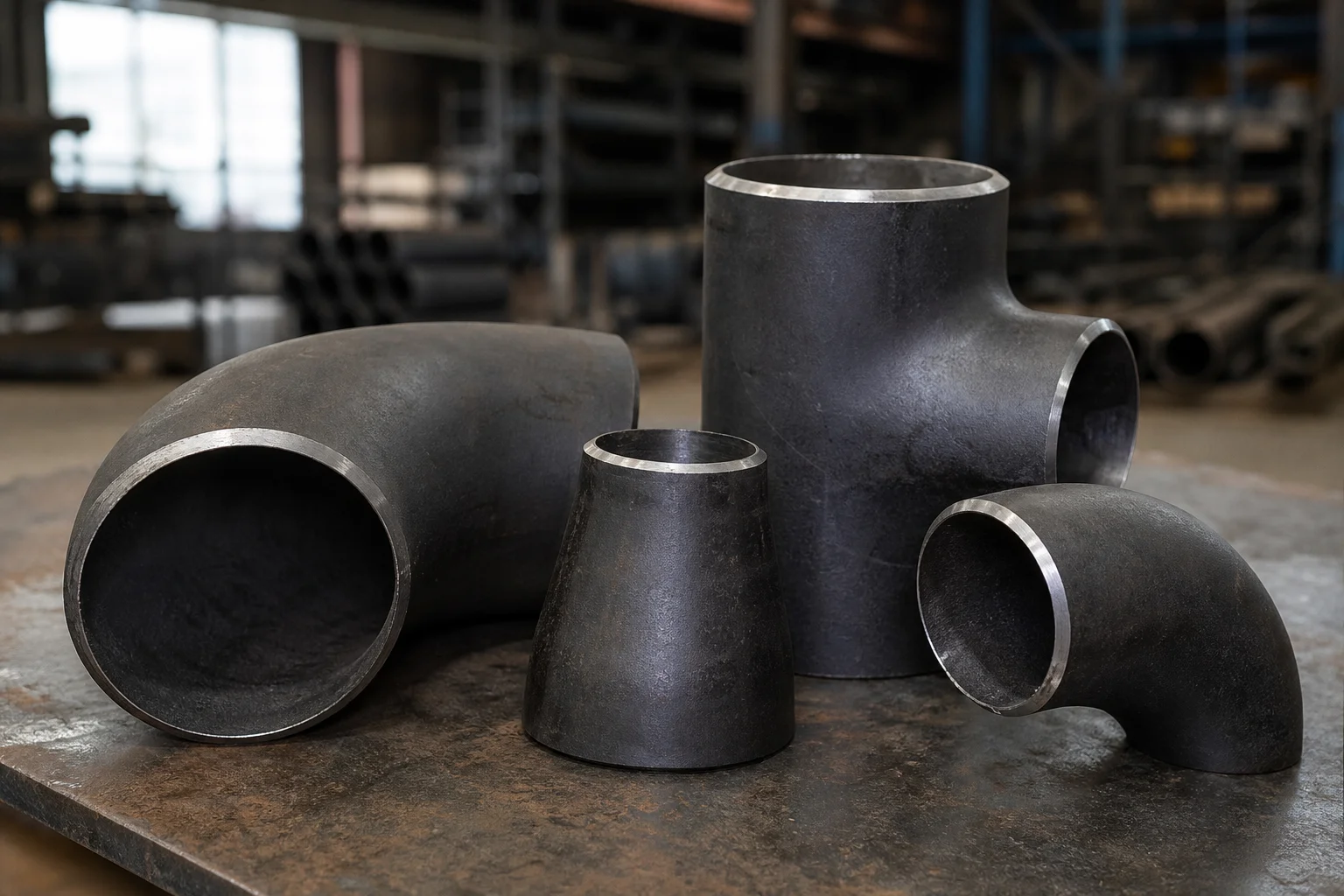
Carbon steel pipe fittings connect, redirect, branch, reduce, or close carbon steel piping systems. Common products include butt-weld elbows, tees, reducers and caps; forged socket-weld or threaded fittings; flanges; branch fittings; and fabricated specials. A technically complete order must identify the product form, material specification and grade, nominal size, wall thickness or pressure class, dimensional standard, manufacturing method, service conditions, inspection, coating, marking, and certification.

The phrase “carbon steel fittings” is not a material grade. It also does not establish whether a product is wrought, forged, cast, welded, or fabricated. Buyers should avoid treating “mild steel fittings,” ASTM designations, EN grades, and national grades as automatic equivalents. The correct specification depends on the fitting type, manufacturing route, piping code, and project line class.

Carbon steel pipe fittings for industrial piping

Why It Matters for Pipe Components

Carbon steel is widely used because it offers practical strength, weldability, availability, and cost for many industrial services. However, the same broad material family can cover very different products. A butt-weld reducer formed from wrought material, a forged socket-weld elbow, a plate-fabricated tee, and a cast threaded fitting may all be described informally as carbon steel, yet they do not share the same manufacturing controls or standard requirements.

Ordering the wrong product form can create problems with weldability, dimensions, pressure design, impact properties, corrosion allowance, heat treatment, or documentation. A supplier may quote a visually similar item that cannot be accepted under the project specification. This is why the material designation must be connected to the exact component type.

Carbon steel pipe fittings also interact with pipe schedules, valve ends, flange bores, branch geometry, and field welding. Correct end preparation and wall matching reduce fit-up problems. Correct traceability allows the project team to link the installed item to its heat or lot documentation.

Methods, Parameters, or Process

Which carbon steel fitting types are commonly supplied?

Product groupTypical examplesMain ordering basis
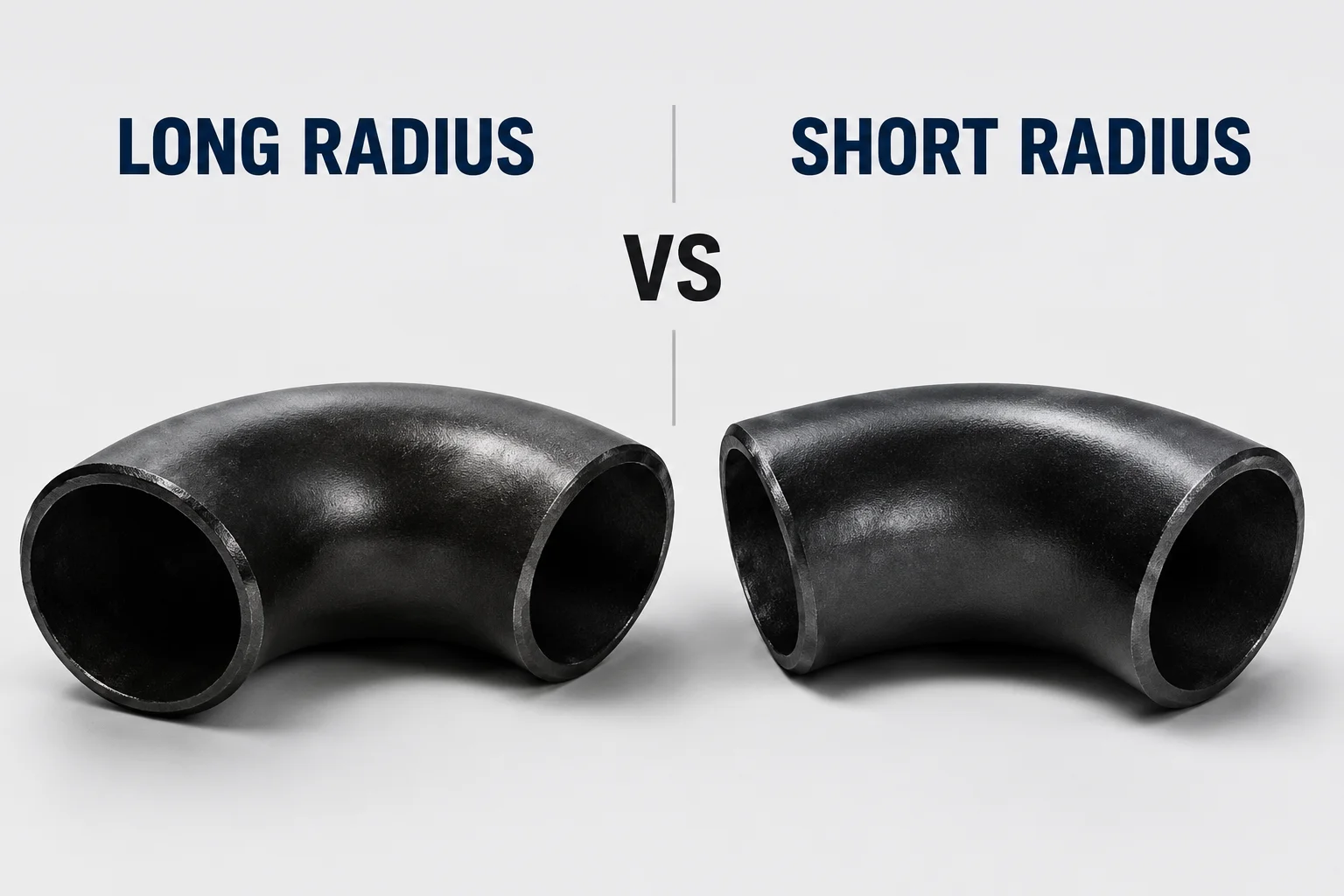
Wrought butt-weld fittingsLong- and short-radius elbows, tees, reducers, capsNominal size, end wall, dimensional standard, material specification
Forged fittingsSocket-weld elbows and tees, threaded fittings, couplings, unions, branch outletsSize, pressure class, end type, material grade, dimensional standard
FlangesWeld neck, slip-on, socket-weld, threaded, blind, lap-joint and special flangesSize, class or PN, facing, bore, material, standard
Fabricated fittingsLarge tees, laterals, reducers, bends, special manifoldsApproved drawing, plate or pipe material, weld details, NDT and design basis
Branch fittingsWeldolets, sockolets, threadolets and other branch connectionsHeader size, branch size, class or wall, contour, material and design standard

A product name should be expanded into a complete line description. For example, a carbon steel elbow requires angle, radius, nominal size, end wall thickness or schedule, material grade, dimensional standard, end preparation, quantity, and inspection requirements.

How do seamless, welded, forged, and fabricated fittings differ?

“Seamless” usually describes a fitting manufactured without a longitudinal weld seam in the finished body. “Welded” may describe a fitting formed from welded pipe or plate, or a fitting with one or more manufacturing seams. “Forged” describes a product shaped from forged stock. “Fabricated” describes an assembly produced from pipe, plate, fittings, or formed pieces joined by welding.

These terms are not quality rankings by themselves. Suitability depends on the applicable material specification, dimensional standard, design rules, manufacturing procedure, heat treatment, examination, and service. A properly designed and inspected fabricated fitting may be the approved solution for a large or nonstandard size. A seamless fitting is not automatically acceptable if the material grade, wall thickness, dimensions, or documentation are wrong.

Buyers should ask the supplier to identify the manufacturing route and any weld seams. If seam examination or weld procedure documentation is required, state it in the RFQ.

Which material grades may be specified?

Project specifications may call for different carbon steel grades according to product form and service. Common industry examples include wrought fitting grades, forging grades, plate grades, pipe grades, low-temperature grades, and EN-designated pressure-purpose steels. The exact designation should be copied from the approved line class or material requisition.

ASTM A234 WPB is often requested for wrought carbon steel butt-weld fittings, while ASTM A105 is often requested for forged piping components. These examples should not be generalized to every fitting, flange, temperature range, or project. Low-temperature service, sour service, higher strength, impact testing, or special heat treatment can require another grade or supplementary requirement.

“Mild steel” is a broad commercial expression. It does not prove compliance with a pressure-piping material specification. Likewise, P235GH, P265GH, ASTM A234 WPB, ASTM A105, and Chinese or GOST grades should not be treated as direct equivalents without a documented engineering review. Chemical composition, mechanical properties, heat treatment, thickness range, product form, and testing requirements must be compared.

Which dimensional and material standards should be confirmed?

For factory-made wrought butt-weld fittings, ASME B16.9 is a common dimensional reference when the project uses the ASME system. Forged socket-weld and threaded fittings may use ASME B16.11. Flanges within the applicable scope may use ASME B16.5. These standards do not replace the material specification, piping code, or project line class.

European, ISO, DIN, EN, GOST, JIS, and other systems use different product definitions and designation methods. Do not combine a material grade from one system, dimensions from another, and a pressure designation from a third system unless the project explicitly approves that combination.

The purchase order should state the standard number and required edition. If the edition or standard is missing, use [verification required]. For custom fittings, include an approved drawing and identify the design basis, dimensional tolerances, material, welding requirements, heat treatment, and examination.

How do size, schedule, wall thickness, and pressure class affect the order?

Butt-weld fittings are normally matched to pipe by nominal size and end wall thickness. A schedule designation can be useful, but actual wall requirements should be checked where corrosion allowance, machining, end transitions, or special schedules apply. Reducers and reducing tees require more than one size. Each end or branch should be listed.

Forged fittings are commonly ordered by nominal size, end type, and pressure class. Threaded and socket-weld classes are product-specific designations and should not be confused with flange classes or pipe schedules. Flanges require size, pressure class or PN, facing, bore or matching schedule where applicable, and material.

Pressure suitability is not determined by the fitting name alone. The piping code, component standard, material, design temperature, corrosion allowance, weld joint, and connected components all matter. The project engineer should confirm the rating basis.

What surface treatments and corrosion protection options are available?

Carbon steel may be supplied bare, oiled, painted, coated, galvanized, or with a project-specific corrosion-protection system. Temporary shop primer is not the same as a final service coating. Black mill scale or a dark surface is not proof of material grade.

Specify whether the coating is temporary or permanent, the surface preparation, coating system, dry-film thickness where applicable, color, uncoated weld areas, galvanizing requirement, touch-up method, and holiday or adhesion testing if required. Internal coatings require special attention to fluid compatibility, cure, thickness, end masking, and inspection.

For buried, marine, humid, chemical, or high-temperature service, corrosion protection should be selected as part of the system design. A fitting coating must be compatible with the adjacent pipe, field-joint system, welding process, and operating temperature.

Supplier and Inspection Checklist

  • Confirm fitting type, angle, radius, run size, branch size, reducing direction, and end connection.
  • Confirm material specification, grade, product form, heat treatment, and any impact or hardness requirements.
  • Verify outside diameter, end wall, center-to-end dimensions, bevel, bore, socket, thread, flange drilling, and facing as applicable.
  • Check heat or lot traceability against the material test certificate.
  • Identify manufacturing seams and verify required examination records.
  • Confirm visual condition, laminations, cracks, laps, scale, dents, and end damage are within the acceptance basis.
  • Check marking content, permanence, transfer method, and traceability after coating.
  • Verify coating or galvanizing requirements, including protected weld ends.
  • Confirm required inspection documents, release notes, test reports, and certificate type.
  • Review packaging for bevel protection, flange-face protection, thread caps, separation by heat or line item, and seaworthy shipment where required.

Do not request “full inspection” without defining it. State dimensional inspection coverage, visual acceptance, NDT method and extent, mechanical testing, coating inspection, document review, third-party witness points, and governing acceptance criteria.

Application to Pipe Fittings, Valves, and Flanges

Carbon steel fittings are commonly installed between carbon steel pipe, flanges, and valves, but compatibility must be verified at each joint. A weld-neck flange bore should suit the pipe wall and fitting transition. A butt-weld valve end should match outside diameter, wall, bevel, and material group. A threaded valve cannot be connected safely by choosing any black threaded fitting that happens to engage.

Reducers installed near pumps or valves must follow the piping layout and hydraulic design. Orientation can affect drainage, air accumulation, cavitation risk, and maintenance. Tees and branch fittings must match the branch design and reinforcement approach. Fabricated headers require approved drawings and weld examination requirements.

Dissimilar materials can introduce galvanic, welding, or thermal-expansion concerns. When carbon steel joins stainless steel, alloy steel, lined pipe, or nonmetallic pipe, the transition design should be reviewed by the project engineer. Coating continuity and electrical isolation may also be required.

FAQ

Are carbon steel fittings and mild steel fittings the same?

Not necessarily. Mild steel is a broad commercial description. Pressure-piping orders should state an approved material specification and grade for the exact fitting product form.

What is the difference between a forged fitting and a butt-weld fitting?

Forged fittings are produced from forged material and commonly use socket-weld or threaded ends in defined classes. Butt-weld fittings are prepared for welding directly to pipe and are commonly ordered by nominal size and end wall thickness. The applicable standards and service limits differ.

Can ASTM A105 be used for all carbon steel fittings?

No. ASTM A105 is commonly associated with forged carbon steel piping components, but it should not be assumed for wrought butt-weld fittings, fabricated fittings, every temperature range, or every project.

Is Schedule 40 enough information for a fitting order?

No. State the nominal size, product type, material, dimensional standard, end connection, actual or required end wall, quantity, and inspection requirements. For reducing products, identify all end sizes.

Which certificates should be requested?

The required certificate type depends on the project. Buyers commonly request material test certificates, heat-treatment records where applicable, dimensional reports, NDT reports, coating reports, and a certificate of conformity. Define the document standard and content in the purchase order.

Next Steps

Send a line-item RFQ that states fitting type, angle or branch arrangement, nominal size, schedule or end wall, material specification and grade, dimensional standard and edition, manufacturing route, quantity, coating, marking, inspection, certificate type, packaging, delivery location, and required date. Include drawings for fabricated or nonstandard products and mark unresolved material equivalence or standard questions as [verification required].

Request a Quote

関連メモ

Pipe Fittings Guide: Types, Materials, Standards and Selection
製品の選択

Pipe Fittings Guide: Types, Materials, Standards and Selection

A practical guide to industrial pipe fittings, covering fitting functions, connection methods, materials, dimensional terminology, applicable documents, inspection points, and the information buyers should include in an RFQ.

Black Pipe Fittings: Types, Materials, Threads and Industrial Uses
製品の選択

Black Pipe Fittings: Types, Materials, Threads and Industrial Uses

An industrial guide to the ambiguous term black pipe fittings, explaining how black steel, malleable iron, forged steel, threaded, welded, and coated products differ and what buyers must confirm before ordering.

How to Measure Pipe Fittings: NPS, DN, OD, ID and Thread Size
製品の選択

How to Measure Pipe Fittings: NPS, DN, OD, ID and Thread Size

A step-by-step method for identifying an unknown pipe fitting by nominal size, outside diameter, wall thickness, connection type, thread form, center-to-end dimensions, flange details, markings, and clear reference photographs.

河北省 河北省

オンラインカスタマーサービス

ジエ・アイジョン

いつでもご質問ください。ただ早期返信レターします。